Thursday, 17 August 2017

Tuesday, 1 August 2017
Our WIT email
To Mrs Parkes and Mrs Mills,
Our WIT group, Georgia T, Kayla and Liam, have been studying invertebrate insects from Frankley School bush and want to share our final resource with year 3 and 4’s (your class age-group).
Is it okay if we organise a suitable time this week to come into your class and ask a small group of kids, about 1-3, some questions that will help us with our task?
These are the questions that we will ask the students when we come in.
- Which device do you use most? (computers / ipads…….)
- Will you be interested in an online game?
- Are you interested in learning about insects in the Frankley School bush?
- Can we have a look at your work in the classroom, and the type of books you read?
- If you could make a choice to be read to or to read a book, which one would you choose?
Kind regards,
Georgia T, Kayla, and Liam
Wednesday, 26 July 2017
Information Report
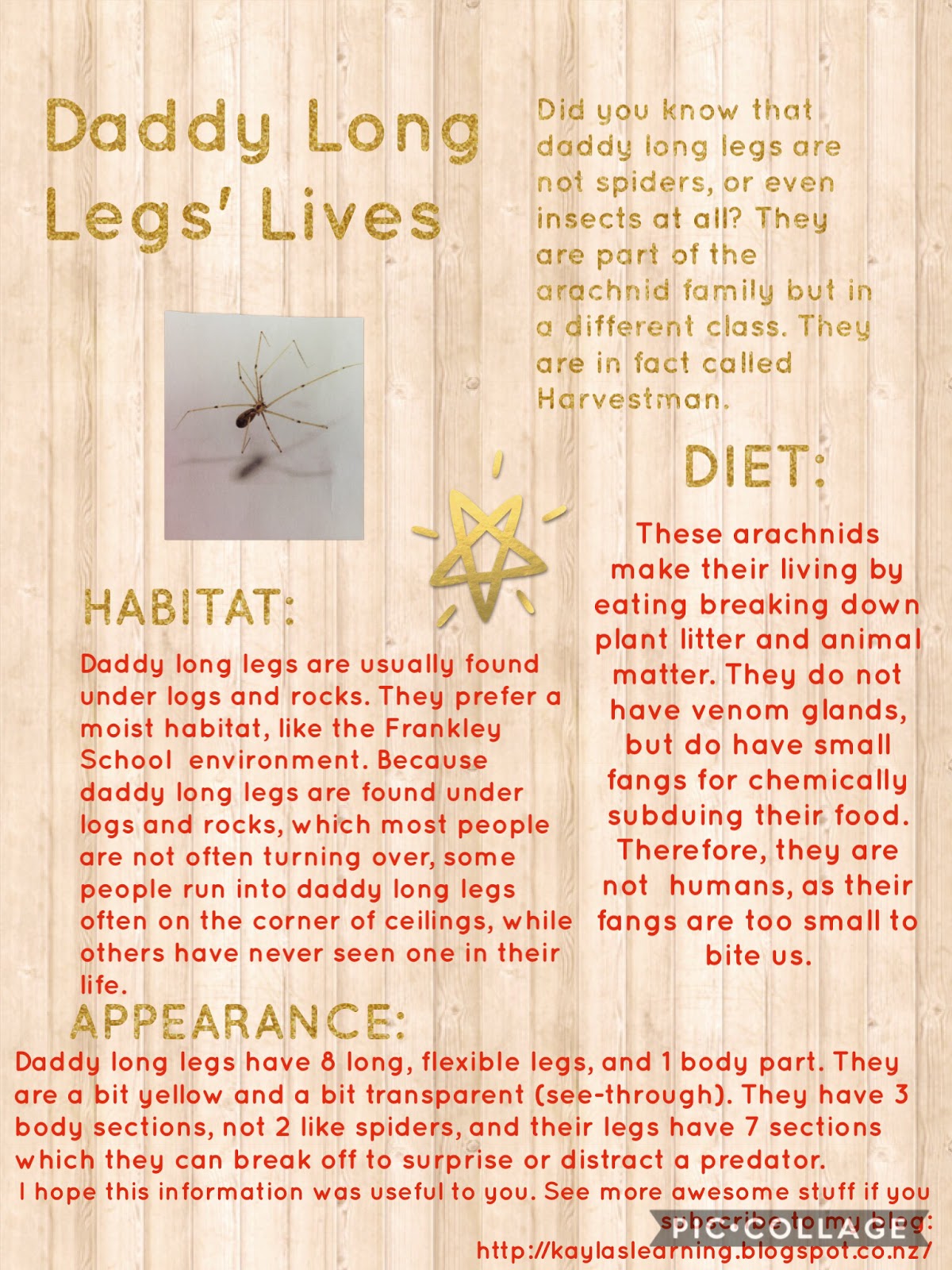
This is my information report for our W.I.T task. It is about daddy long legs spiders.

Monday, 19 June 2017
My Prove It
Click on the link below to access my explain everything prove-it.
Explain Everything
I posted this because I really wanted to prove my goal and get it over with.
I hope you like it! 😎
Thursday, 1 June 2017
Woodlice Facts
Woodlice Facts

-
Most species of woodlice can reach 0.1 to 1.1 inches in length
-
Woodlice have a tough outer shell, called an exoskeleton, on the surface of the body
-
Most species of woodlice are gray, brown or (rarely) reddish-orange coloured
-
Woodlice have segmented bodies and 14 legs
-
Most species of woodlice are active during the night (nocturnal)
-
Woodlice can survive 2-4 years in the wild, depending on the species
- Oxygen-rich blood of woodlice is blue-coloured
I am posting this because our W.I.T
(Wildly Important Task) is based on invertebrate insects of the Frankley School bush. Our group caught a couple of woodlice (we named the Clicky and Flicky); so I thought I would do some facts around them.

Most species of woodlice can reach 0.1 to 1.1 inches in length
Woodlice have a tough outer shell, called an exoskeleton, on the surface of the body
Most species of woodlice are gray, brown or (rarely) reddish-orange coloured
Woodlice have segmented bodies and 14 legs
Most species of woodlice are active during the night (nocturnal)
Woodlice can survive 2-4 years in the wild, depending on the species
Wednesday, 12 April 2017
Thursday, 30 March 2017
Vertical Horizons
This is my Camp Vertical Horizons slideshow. I hope you enjoy it.
Have you ever been there?
Subscribe to:
Posts (Atom)